

As a cornerstone of modern life, energy has become more critical than ever. We are at a crossroads: while developed and emerging economies face soaring energy demands, nearly 17% of the world's population still lacks basic electricity access. Coupled with the urgent goal of limiting global warming to +1.5 °C, it is clear that we must take decisive action in how we manage energy.
The priority is ensuring that energy consumption remains sustainable despite increasing demand. Energy sustainability means meeting the needs of the present without ignoring the requirements of future generations. Ultimately, the core objective is to guarantee that energy remains a viable resource for all future generations.
Energy efficiency is key to ensuring sustainability for both the energy sector and individual enterprises. The data is undeniable: a well-structured Energy Management System provides an additional 10% in savings compared to traditional approaches (up to a 3x increase).
A Holistic Approach to Energy Management: ISO 50001 Energy Management Systems
In energy efficiency, the most important point to consider is to remove these efforts from the initiative of individuals and manage them in a systematic manner. At this point, the solution comes into play as the “ISO 50001 Energy Management System.” ISO 50001 is an Energy Management System standard created by bringing together energy experts from more than sixty countries, compiling all energy efficiency and energy management practices carried out over many years. It includes the essential requirements of a management system at the most fundamental level andaims to establish a globally consistent framework.".
An Energy Management System means looking at every stage, from product procurement and design to maintenance agreements, through the lens of 'energy' and ensuring continuous performance improvement. It is a culture shift that must involve all stakeholders, from Energy Managers to CFOs, and must be embraced across the entire organization.
ISO 50001 Implementation Steps: A Roadmap to Success
There are certain points that need to be followed during the implementation phase of the ISO 50001 Energy Management System (EnMS). In this section, we will examine the steps that should be followed in this process.
1. Capture the Current State: Know exactly where you stand before you begin. Assess your organization’s current energy management expertise, identify internal and external factors impacting consumption, and determine the expectations of your stakeholders.
Critical Question: "Do we truly know who, why, and how our energy bills are increasing?"
2. Define the Scope Clearly: Determine which facilities and energy types (electricity, natural gas, LPG, water, etc.) will be included in the system. Draw clear boundaries.
3. Establish an Energy Policy: An energy policy backed by senior management's signature demonstrates your commitment to:
- Continuous improvement of energy performance
- Full compliance with legal and regulatory requirements
- Ensuring the availability of necessary information and resources
4. Form the Energy Team: The success of the system depends on the diversity and breadth of your team; an energy manager alone is not enough. At a minimum, representatives should include:
- Senior Management
- Production
- Maintenance & Quality Management Systems
- Human Resources
- Purchasing
5. Map Out Risks and Opportunities:
- What risks threaten your energy consumption? (e.g., rising prices, aging equipment, inefficient processes)
- What opportunities lie ahead? (e.g., new technologies, incentives, efficiency projects)
Develop concrete action plans for every risk and opportunity identified.
6. Set Objectives and Targets: With a 4-5 year perspective:
- Which efficiency-enhancing projects will you implement?
- What is the feasibility of each project?
- What are your measurable targets?
Example: "Reduce kWh/ton consumption in production processes by 15% between 2025-2029."
7. Conduct an Energy Review: Bu aşama ISO 50001 Enerji Yönetim Sistemi’nin kalbini oluşturur. Tüm enerji tüketimlerinizi ve maliyetlerinizi düzenli analiz edin:
Visualize Energy Flow with a Sankey Diagram:
- Identify which departments, equipment, or systems have the highest consumption.
- Track exactly where your energy costs are going.
Example Energy Review
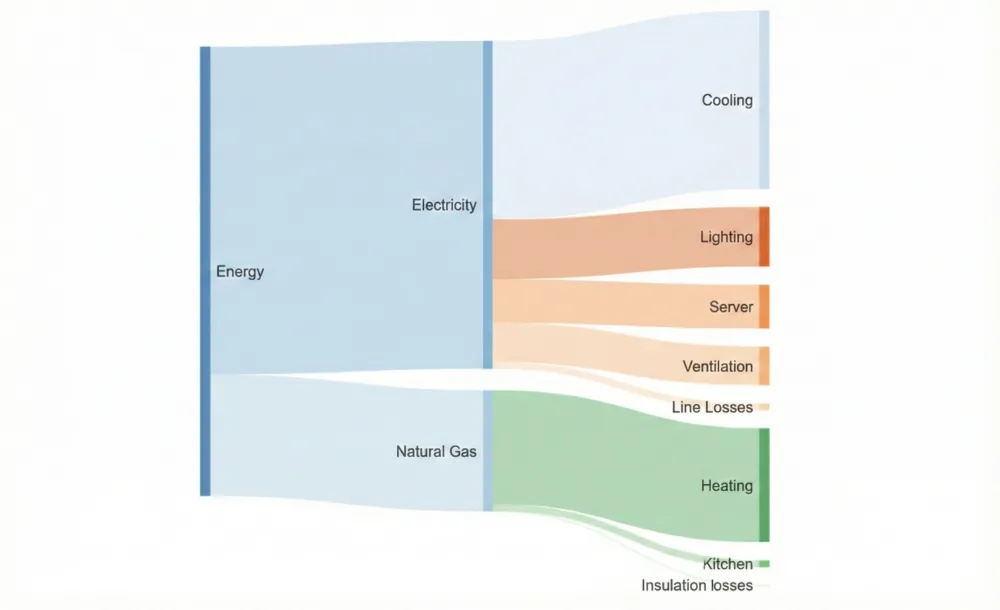
Based on the Sankey diagram above, here are SEUs (Significant Energy Uses):
- Electricity SEUs: Cooling, Lighting, Servers, and Ventilation systems.
- Natural Gas SEUs: Heating systems.
.
8. Define Energy Performance Indicators (EnPIs): A specific Energy Performance Indicator (EnPI) must be established for every identified SEU. An EnPI demonstrates the specific performance criteria by which that SEU will now be measured. For instance, if you have identified production machinery as an SEU, its performance indicator could be parameters such as kWh/ton or kWh/unit.
Example Energy Performance Indicators (EnPIs)
The EnPIs for the SEUs identified in an enterprise might look like the following:
| SEU Example | EnPI Alternative |
| Production | kWh/ton, kWh/unit, Sm3/kg, lt/m2… |
| Heating Systems | kWh/production volume, kWh/HDD... |
| Cooling Systems | kWh/production volume, kWh/CDD... |
| Compressed Air Systems | kWh/production volume, kWh/m3 of air produced... |
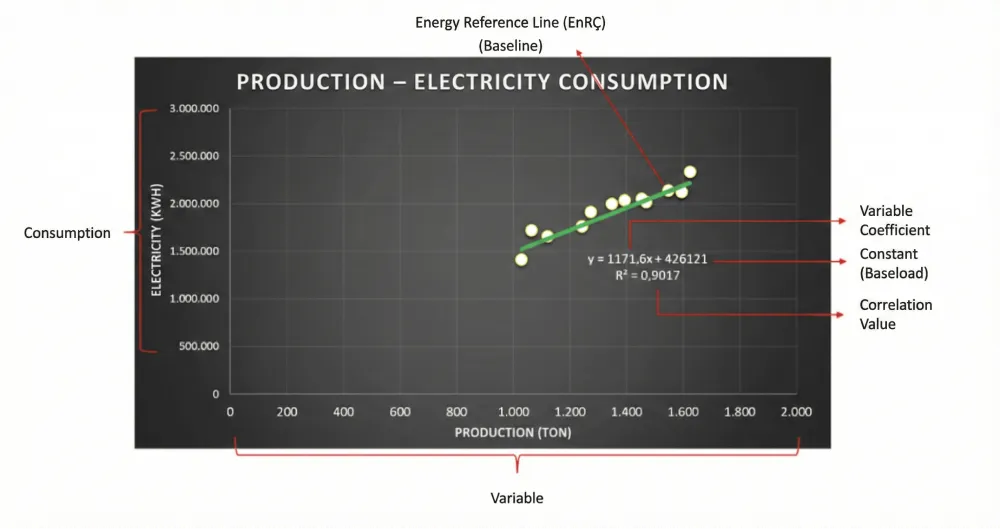
9. Establish an Energy Baseline (EnB): An energy baseline must be established for the specific performance criteria (EnPI) defined for each SEU. This baseline creates a benchmark against which we will strive to improve our energy performance moving forward.
Example Energy Baseline (EnB)
10. Create an Energy Data Collection Plan: Organizations must review current methods for collecting the data necessary for energy analysis and plan how to address any existing gaps. Furthermore, the accuracy of data from existing measurement devices must be verified; therefore, a calibration and verification plan for these devices is essential.
11. Mobilize ResourcesThe enterprise must demonstrate its commitment by allocating resources to energy efficiency and management. These resources can be financial, human, or specific activities such as sending personnel for specialized training. Additionally, organizations should enhance employee competency and awareness through training sessions, meetings, brochures, informative emails, videos, and posters. Implementing a suggestion and reward system also significantly boosts internal awareness.
12. Open Communication Channels:
- Ensure it is clear who communicates with whom and how.
- Define how energy announcements will be made.
- Mandatory: A suggestion system.
- Strongly Recommended: A reward system.
13. Document Everything: All activities carried out within the EnMS (Energy Management System) must be documented, recorded, and protected. A comprehensive documentation system should be developed and strictly implemented to ensure traceability.
14. Update Operational Plans:Now that an energy efficiency and management perspective has been established, existing operation and maintenance plans must be reviewed. These plans should be updated to incorporate specific improvements for energy-efficient operation and proactive maintenance.
15. Integrate Energy Criteria into Design and Procurement: Businesses must prioritize energy-efficient design and procurement. For new or renewed facilities, equipment, systems, and energy-consuming processes, especially those with a significant impact on energy performance, energy efficiency criteria must be a core requirement during both the design and purchasing stages.
16. Monitor Legal Requirements: It is your responsibility to identify and fulfill your legal obligations regarding energy efficiency. Regulatory bodies are not required to provide individual notifications; staying compliant requires proactive monitoring of the legislative landscape.
17. Conduct Internal Audits: Regularly audit your system to ensure ongoing compliance with ISO 50001 standards. Internal audits are essential for identifying gaps and maintaining system integrity.
18. Management Review: Senior management should hold periodic review meetings to evaluate energy performance, assess the effectiveness of the system, and update strategic targets for the upcoming period.
Reporting in the ISO 50001 Energy Management System: Make Your Success Visible
Following the implementation of an energy management system, establishing robust reporting processes is essential for documenting success and tracking continuous improvement. To ensure system performance is accurately recorded and measurable, the following reports should be generated on a regular basis:
- Energy Performance Reports:
These reports should be prepared based on predefined energy performance indicators. They highlight the total savings achieved in energy consumption, the specific impact of efficiency projects, and the resulting financial advantages.
- Senior Management Reports:
Reports designed for executive review must include advancements in energy performance, key actions taken, and strategic plans for future improvements.
- Monitoring and Analysis Reports:
These reports are used to track energy consumption trends, identify abnormal consumption patterns, and measure the realization rates of projected savings.
- External Reporting and Certification Reports:
These documents are specifically prepared for external auditors to support and facilitate the ISO 50001 certification process.
Automate Your ISO 50001 Process with Apollo
The most complex and time-consuming aspects of implementing ISO 50001 typically include:
- Continuous data collection and analysis
- Calculating EnPI (Energy Performance Indicators) and EnB (Energy Baselines)
- Maintaining regular reporting schedules
- Ongoing performance monitoring
Apollo OptWise automates these critical processes:
- ✅ Automatic Data Collection: Monitor your energy consumption in real-time with zero manual effort.
- ✅ Smart EnPI and EnB Calculation: ISO 50001 Enerji Yönetim Sistemi’nin en karmaşık kısmını Apollo otomatik yapar
- ✅ Automatic Alarms and Reports: Regularly deliver customized reports and instant alerts to designated team members.
- ✅ One-Click Performance Analysis: Access and share complex data analyses with just a few clicks.
- ✅ Industry Benchmarking: Compare your company’s energy intensity against industry averages to see exactly where you stand in the market.
- ✅ Expert Support: Our expert team in energy efficiency and management is always available to support your journey.