

Energy is one of the most critical inputs for businesses. When not managed effectively, it can directly impact costs and key performance indicators.
Energy efficiency analysisgoes beyond merely tracking consumption values, it requires accurately understanding the underlying reasons for changes in energy use. Grasping the fine line between efficiency and savings, and analyzing the factors driving consumption fluctuations, form the foundation of effective energy management.
But what tools are necessary to achieve this? The ISO 50001 energy management standard recommendsregression analysis as a key method for normalizing energy consumption and evaluating performance. In this article, we explore how regression analysis is transforming energy efficiency assessments and examine the potential of AI-driven models in this domain.
Enerji Energy Efficiency or Saving?
For many, energy efficiency still simply means consuming less. However, the distinction between energy efficiency and energy savings lies in understanding why consumption changes and being able to analyze the current situation based on that insight.
The energy consumption of a building, industrial facility, or street-level store is never constant. Production levels may fluctuate, visitor numbers vary, weather conditions change, or new equipment is introduced. All of these variables impact energy use. Simply stating, “My energy consumption increased compared to last month,” is not sufficient data to conclude poor energy efficiency performance.
This is where regression analysis comes into play, a method recognized by the The ISO 50001 standard, to help make sense of energy consumption patterns.
What is Regression Analysis of Energy Consumption?
Regression is a statistical method used to understand which factors influence energy consumption and to what extent. In energy management, regression considers consumption not just as raw data, but in relation to variables such as production levels, operating hours, weather conditions, and process parameters. This approach provides a different perspective on questions like, “Why did we consume more energy this month?”
Regression analysis is a powerful tool for making sense of energy consumption. However, if applied incorrectly in the field, its full potential is often not realized.
- When conducting an energy efficiency study, questions such as “Where should we start and what should we pay attention to?” arise. Energy Efficiency Management Self-Assessment, a practical guide for on-site applications, provides immediate answers and actionable steps.
The Evolution of Regression Analysis: From Classical Approaches to Apollo Models
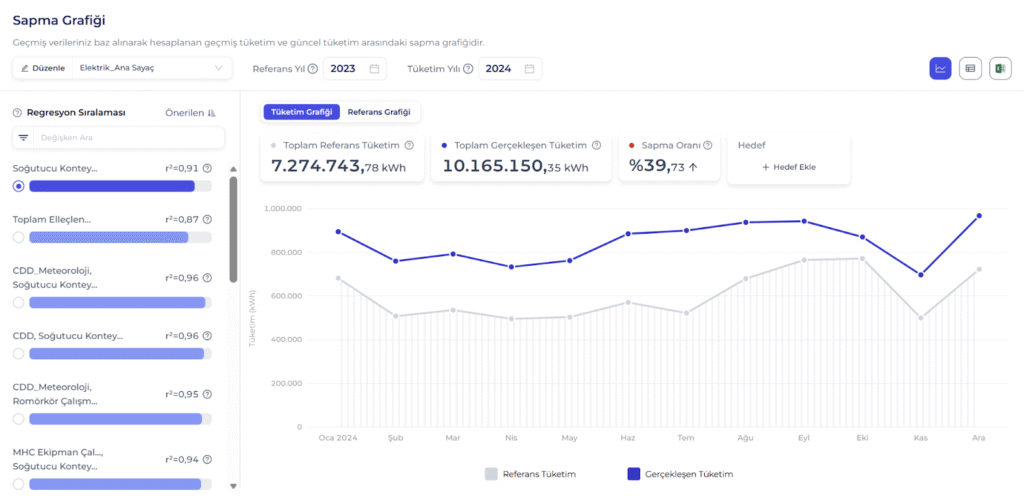
Apollo’s automated regression modelsoperate independently of individual biases. Its AI-driven regression infrastructure analyzes the variables affecting energy consumption across all possible combinations , automatically evaluating the model variations with the highest R² value for up to three variables. This process is not limited to the initial setup; it continuously repeats as new data flows in. Over time, the model updates itself and adapts to current operational conditions.
One of the most significant contributions of regression analysis is that it does more than just explain the historical data.
By analyzing past and actual consumption together on a monthly and yearly basis, in relation to relevant variables, it becomes possible to clearly forecast future energy consumption and assess energy efficiency performance against these projected levels.
Apollo OptiWise's approach is not only possible to predict consumption, but also to measure how efficiently operations are running.
Digital Transformation in Energy Management with Apollo: Efficiency, Consistency, Sustainability
1. From Individual Dependence to Corporate Memory
Relying on individuals for energy management knowledge poses a significant risk. Storing analyses in personal files can lead to information loss and process resets when personnel change. A system-based energy management approach eliminates this risk by preserving institutional memoryApollo consolidates all historical analyses and indicators on a single platform, making them accessible to all teams.
2. Time Savings and Operational Efficiency
Manual data collection, scattered file analyses, and repetitive calculations in energy management processes result in substantial time and labor losses. A system-based approach executed through automation and a centralized platform eliminates these inefficiencies, reducing analysis time and operational costs. Apollo automatically processes daily, monthly, and yearly consumption data, enabling engineering and technical teams to focus on action and improvement rather than reporting.
3. Consistent Analyses
Evaluating variables that influence energy consumption such as production levels, operating hours, weather conditions, and process loads, individually can lead to misleading results. A multivariable regression approach links energy use to actual operational conditions, ensuring accurate performance interpretation. Apollo considers multiple variables within the same model, normalizing energy intensity and providing comparable, consistent analyses free from seasonal fluctuations.
See Apollo in action and discover how it can add value to your operations — request a demo.